See the Card by Rackside
It isn't fifty-some hands. It's about ten families.
See the Card teaches you to read the American mahjong card by its families, so you can look at your tiles and know where to look on your card. A printable guide in large type you can read at arm's length.
2468 rack
Get See the Card, $37- Instant download
- PDF + printables
- 30-day refund
- Use with any year's card
Why the card feels impossible
You know how the game flows. You can sort your tiles. You know a pung from a pair.
Then you pick up the card.
Fifty-some lines of tiny numbers and colors. You start at the top and read down, line by line, hoping one of them looks like your rack. By the time you find a maybe, everyone else has passed.
It isn't you. It's how the card gets taught.
If you were handed the card and told to read it top to bottom, it's like a menu with fifty-some dishes and no headings. You end up trying to hold every line in your head at once. That's too much for anyone.
And every spring a new card arrives, the lines change, and it can feel like starting over.
Here is the piece that's missing: the table of contents.
The card is organized into families
The card isn't fifty-some random hands. Its lines are grouped into sections, and each section is a family of hands built on the same idea. There are about ten of them, and the same kinds of families come back year after year.
Learn the families, and the card stops being a wall of lines. It becomes about ten sections, and only one or two of them matter for the tiles in front of you.
Here are the ten families we teach, and the tell for each one. A tell is what the family looks like on your rack, so you can spot it at a glance.
2468
Mostly even numbers: 2s, 4s, 6s and 8s
13579
Mostly odd numbers: 1s, 3s, 5s, 7s and 9s
369
Mostly 3s, 6s and 9s
Like Numbers
The same number showing up in two or three suits
Consecutive Run
Numbers in a row, like 4, 5, 6, 7
Winds and Dragons
Lots of winds and dragons
Singles and Pairs
Pairs everywhere, and no Jokers allowed
Quints
Five of a kind. A set has only four of each number tile, so these lean on Jokers
Year
Uses the digits of the card's year, with the White Dragon standing in for zero
Addition
Numbers in a line that add up. We teach this one as reading, not scanning
These are general names for how the card's sections are organized. We describe what each family looks like on your rack. We never print the card's lines.
Don't read the card first. Read your rack first.
This is the method in the guide. We call it Scan Your Tiles, and it has four steps: Sort, Tally, Fingerprint, Shortlist.
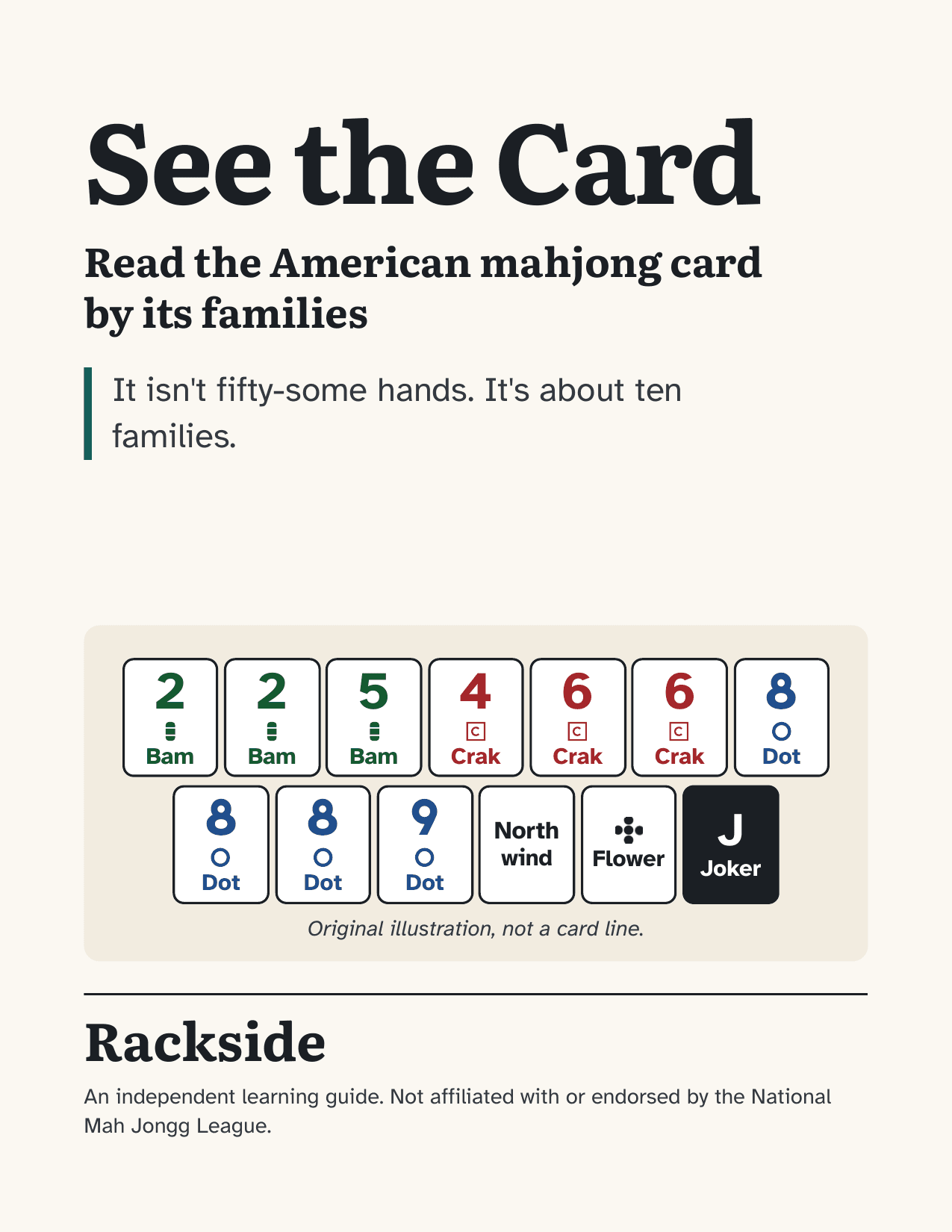
Here's a rack we made up to show it. These are 13 tiles you might be dealt.
In words: two 2 Bams, a 4 Crak, two 6 Craks, three 8 Dots, a Joker, a Flower, a 5 Bam, a 9 Dot and a North.
Looks like a mess. Let's scan it.
Step 1: Sort
Bams, then Craks, then Dots, then winds and dragons, then Flowers and Jokers. Same order every time, so you always know where to look.
Step 2: Tally
Count a few simple things. The guide comes with a tally pad for this, or you can do it in your head.
- Even numbers (the 2s, the 4, the 6s, the 8s)8
- Odd numbers (the 5 and the 9)2
- 3s, 6s and 9s3
- Winds and dragons1
- Pairs or more3
- Jokers1
The Joker and the Flower are flexible tiles. Set them aside for the count. They can help you later.
Step 3: Fingerprint
Your highest count names your lead family. Eight even numbers out of 13 tiles is a strong lean.
This is a 2468 rack.
Your next count is only 3, so this rack isn't torn between two families. When two counts are close, the guide shows you how to keep a backup family alive.
Step 4: Shortlist
Now open your own card, and go straight to the 2468 section. Skip everything else. Find the one or two lines that use the most of your tiles.
And look what else just happened. The 5 Bam, the 9 Dot and the North don't fit 2468. Your first three Charleston passes are already decided.
You just went from the whole card to one or two sections of it.
That's the whole idea. The guide walks you through it for all ten families, with practice racks and answers.
Get See the Card, $37What you get
One guide, five printables, instant download. Everything is a PDF you print at home on regular letter paper.
1. The See the Card guide
(49 pages, set in 16 point type)
- Tile check: the suits, winds, dragons, Flowers and Jokers, with the real Chinese characters shown and named
- How the card is built: what the families are and how to read a line, explained in words
- The ten families, one page each: the tell, two practice racks, common traps, and the families next door
- Scan Your Tiles, step by step, with a tie-break chart for close calls
- Jokers: where they can go, and where they never can
- The Charleston, through the family lens: what to pass and what to keep
- The pivot: when to switch hands, and to which family
- New-card night: how to mark up your own new card with our key
- 16 drill racks with answers
- A two-page quick reference
- Play it with your friends: learning together as a group, practice nights, and keeping the table kind to new players
- Why we love this game: the table, the Charleston, and where mahjong comes from
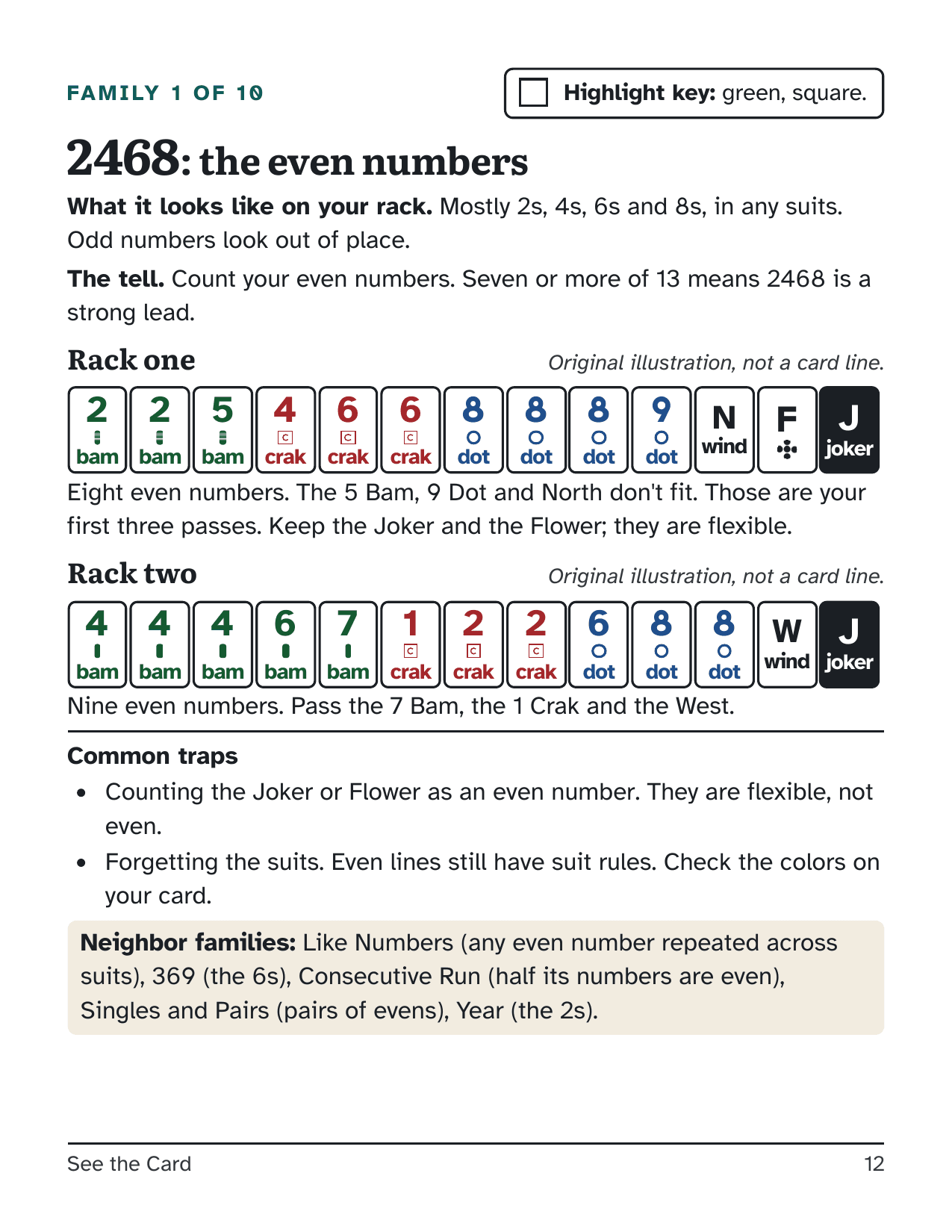
A real page from the guide: the 2468 family.
2. Ten Family Cards.
One per family, half-letter size, made to print and laminate. The tell on the front, traps and neighbors on the back.
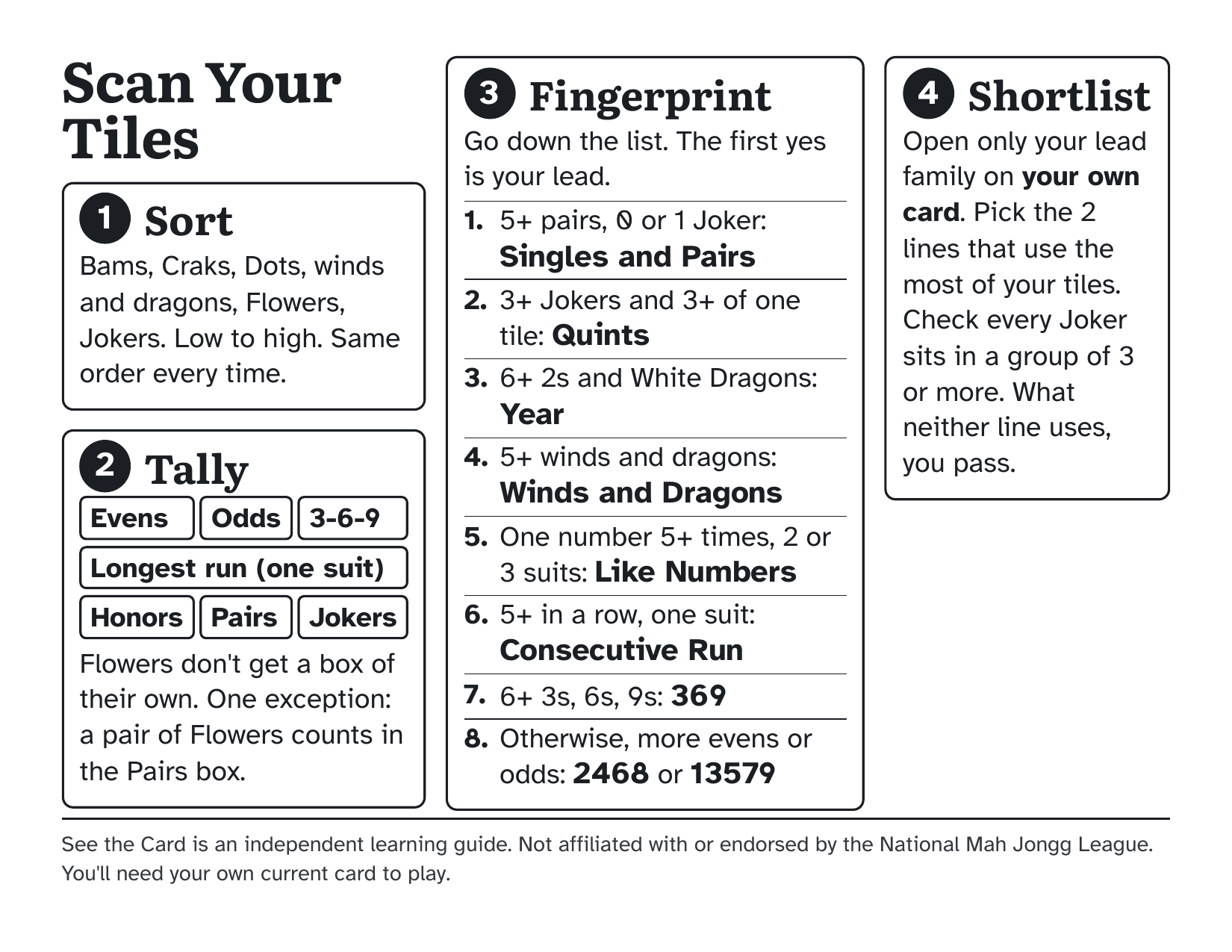
3. The Scan Your Tiles sheet.
One landscape page with the four steps in big type. It sits next to your rack.
4. The Family Tally Pad.
Four tally slips per page. Print as many as you like.
5. The Neighbor-Families Map.
For the moment your hand stops coming together and you need to switch. Shows which families share tiles.
6. The Highlight-Your-Own-Card Key.
A color and a symbol for each family, so you can mark up your own card. You never need a copy of anyone else's.
Plus: a free note when next year's card comes out. When the new card arrives, we'll email you a short note on how the families shifted. Free, for everyone who bought.
$37. One payment. No subscription.
Get See the Card, $37Big type, on purpose
Squinting at small print is part of why the card feels hard. So we built See the Card to be easy on the eyes from page one.
Our guide's body text, at 16 point:
Count your even numbers. Seven or more of 13 means 2468 is a strong lead.
The same words at 8 point, for comparison:
- 16 point type in the guide. Nothing smaller than 14 point anywhere. Printables are bigger still.
- High contrast. Dark ink on warm white. No pale gray text, no words on busy backgrounds.
- Color never works alone. Every color also has a word or a symbol, so the guide works in black and white and for color-blind readers.
- Prints at home. Letter paper, prints fine in grayscale, nothing important near the edge.
- Large type you can read at arm's length. The Scan Your Tiles sheet and Family Cards are sized to read from your rack.
What See the Card isn't
We'd rather you know now.
- It isn't a copy of the card. We never print the card's hands. You'll need your own current card. See the Card teaches you how to read it.
- It isn't a strategy course for experienced players. No defense, no tournament tactics. It's for the first months, when the card is the hard part.
- It isn't a rules course from zero. It helps if you know the basic flow of a game. The guide does start with a quick tile check, so you won't be lost.
- It isn't affiliated with any league. See the Card is an independent learning guide.
Who we are
Rackside is a small team testing a better way to learn the American mahjong card. We're new to teaching mahjong, and we won't pretend otherwise. We built this method from how the card itself is organized, because once we saw the families, the card started to make sense.
We take accuracy seriously. If you spot something wrong, please tell us at hello@seethecard.com. We'll fix it and email you the corrected file.
A word on where the game comes from: Mahjong is a Chinese game that took shape in the 1800s, during the Qing dynasty. It came to America in the 1920s, and the American game, with its yearly card, grew up around a players' league founded in New York in 1937 by a group of Jewish women.
Rackside is operated by Clare Digital LLC.
30-day refund
30-day refund. If See the Card doesn't help the card make sense to you, email us at hello@seethecard.com within 30 days of your purchase and we'll refund your whole order, add-ons included. No forms, no hoops.
Questions
Is this affiliated with the League that publishes the card?
No. See the Card is an independent learning guide. Not affiliated with or endorsed by the National Mah Jongg League. You'll need your own current card to play. We teach you how to read it; we never reprint it.
Do I need my own card?
Yes. We don't print the card's hands, so you'll want your own current card next to you. The guide shows you how to mark it up with our family key.
Which year's card does it work with?
Any recent one. The guide teaches the families, not one year's lines, so you use it with whatever card is in front of you.
Will it still work when next year's card comes out?
That's the reason we built it this way. Each new card changes the lines, but the card keeps its family structure, so you're re-sorting, not starting over. A family can change shape from one year to the next, and once in a while one shows up or drops out. So when the new card arrives, we'll email you a free note on how the families shifted. The guide also has a "new-card night" chapter for marking up your new card yourself.
I'm brand new. Is this too advanced?
If you know how a game flows, you're ready. If you're still learning the tiles, start with the tile check at the front of the guide. If you've never played at all, you'll get more from it after a first lesson or game night.
I've played a while. Is this too basic?
If the card still slows you down, or picking a hand feels like guesswork, it should help. If you're looking for defense or tournament strategy, this isn't that.
How do I get the files?
Right after you pay, you'll see a download page, and we email you the link too. You can come back to it anytime. If you lose the email, there's a page to send yourself a fresh link.
Can I print it?
Yes. That's the plan. Print at 100% on regular letter paper. Print as many copies as you need for your own play.
Is it a printed book?
No. It's a PDF you download and print at home. We may make a printed version someday, but we're not promising one.
Is the type really large?
The guide is set in 16 point type, and nothing is smaller than 14 point. The printables are bigger.
What if it doesn't help?
Email us within 30 days and we'll refund your whole order, add-ons included. No forms, no hoops.
Who are you?
Rackside, a small team testing a better way to learn the American mahjong card. We're new to teaching mahjong. See "Who we are" above.
See your rack. Then see the card.
About ten families. Four steps. One or two sections of your own card instead of all of it.
Get See the Card, $37Instant download. PDF + printables. 30-day refund.